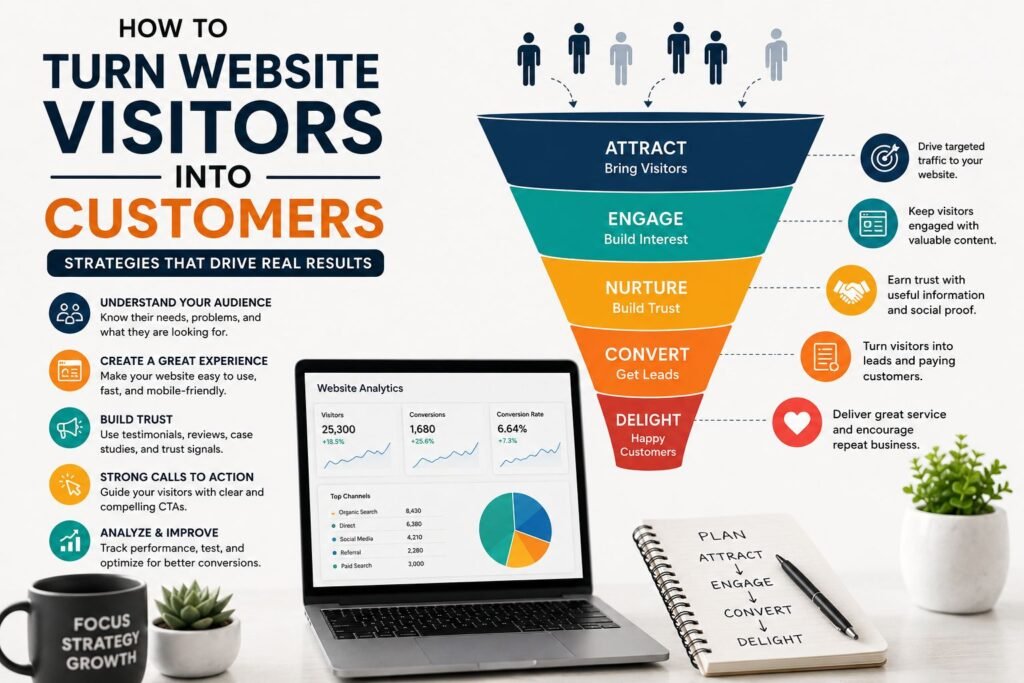
Having a website is an important part of building a successful online business. But simply getting people to visit your website is not enough. The real goal is to turn those visitors into customers.
Many businesses spend time and money on SEO, social media marketing, Google Ads, and other digital marketing strategies to bring visitors to their websites. However, if visitors leave without making a purchase, submitting an enquiry, booking a service, or contacting the business, that traffic may not create meaningful business results.
Turning website visitors into customers requires more than attractive design. It involves understanding your audience, building trust, providing a smooth user experience, and guiding visitors toward the right action.
In this guide, we will explore practical strategies that can help you convert more website visitors into leads and customers.
- Understand Your Target Audience
The first step in converting visitors into customers is understanding who they are.
You need to know what your potential customers want, what problems they are facing, what motivates them, and what prevents them from making a purchase.
For example, a digital marketing agency may target small business owners who want more customers through SEO, social media, and online advertising.
Once you understand your target audience, you can create website content that speaks directly to their needs.
Ask yourself:
- Who are my ideal customers?
- What problem are they trying to solve?
- What questions do they have?
- What concerns may stop them from buying?
- Why should they choose my business?
The better you understand your visitors, the easier it becomes to create a website that encourages them to take action.
- Create a Strong First Impression
Your website is often the first interaction a potential customer has with your business.
Visitors can form an opinion about your business very quickly. If your website looks outdated, confusing, slow, or unprofessional, visitors may leave before learning about your products or services.
Your website should have:
- A clean and modern design
- Easy navigation
- Professional images
- Clear content
- Consistent branding
- Readable fonts
- Mobile-friendly layouts
- Fast-loading pages
A professional website can make your business appear more trustworthy and credible.
Remember, your website does not need to be complicated. It needs to be clear, useful, and easy to navigate.
- Write a Clear Value Proposition
When visitors land on your website, they should immediately understand what your business offers and how it can help them.
This is where a strong value proposition becomes important.
Instead of using a vague headline such as:
“Welcome to Our Website”
use something more specific:
“Grow Your Business with Result-Driven Digital Marketing”
A good value proposition should answer three questions:
What do you offer?
Who is it for?
Why should customers choose you?
When visitors understand your value quickly, they are more likely to continue exploring your website.
- Use Strong Calls to Action
A Call to Action, commonly called a CTA, tells visitors what they should do next.
Without a clear CTA, visitors may not know how to move forward.
Examples include:
- Get Started
- Contact Us
- Book a Consultation
- Request a Quote
- Shop Now
- Learn More
- Download Now
- Get a Free Consultation
Your CTA should be easy to notice and should clearly communicate the next step.
Instead of simply writing “Submit” on a form, you could use:
“Get My Free Consultation”
This gives the visitor a clearer idea of what happens after clicking the button.
- Build Trust with Social Proof
People are more likely to buy from a business when they trust it.
One of the best ways to build trust online is through social proof.
Social proof can include:
- Customer reviews
- Testimonials
- Case studies
- Ratings
- Client logos
- Success stories
- Before-and-after results
- User-generated content
For example, a testimonial saying:
“Our website traffic and enquiries increased after working with this team.”
can be more convincing than a general statement saying:
“We provide excellent digital marketing services.”
Real experiences help potential customers feel more confident about choosing your business.
- Make Your Website Mobile-Friendly
A large percentage of internet users browse websites using smartphones.
If your website works well on a desktop but is difficult to use on a mobile phone, you could lose potential customers.
A mobile-friendly website should have:
- Responsive design
- Easy-to-read text
- Simple navigation
- Large, clickable buttons
- Fast-loading images
- Mobile-friendly forms
- Easy access to contact information
Test your website on different screen sizes and make sure visitors can easily browse and take action from their phones.
- Improve Your Website Speed
Website speed can have a major impact on user experience.
Visitors generally do not want to wait for a slow page to load. If a website takes too long to respond, users may leave and visit a competitor instead.
To improve website performance, consider:
- Compressing large images
- Removing unnecessary plugins
- Using efficient website hosting
- Minimizing unnecessary scripts
- Keeping website software updated
- Using browser caching where appropriate
A faster website provides a better user experience and can support better engagement and conversions.
- Create High-Quality Content
Content can help visitors understand your products, services, and expertise.
Useful website content may include:
- Blog posts
- Guides
- Tutorials
- FAQs
- Videos
- Case studies
- Product descriptions
- Service pages
For example, a company selling skincare products could publish content about skincare routines, product ingredients, and common skincare mistakes.
Helpful content can attract visitors through search engines and gradually build trust with potential customers.
The goal should not be to create content simply for the sake of publishing. Create content that answers questions and helps your target audience make better decisions.
- Simplify the Buying Process
A complicated buying process can cause visitors to abandon their purchase.
If customers have to complete too many steps, create unnecessary accounts, or fill out long forms, they may give up.
Make the conversion process as simple as possible.
For an online store, this could mean:
Product → Add to Cart → Checkout → Payment
For a service business:
Service Page → Contact Form → Consultation → Purchase
Only ask for information that is genuinely necessary.
The easier you make the process, the fewer obstacles visitors face.
- Use Landing Pages
Landing pages are designed to encourage visitors to take a specific action.
For example, if you are running a Google Ads campaign for SEO services, instead of sending visitors to your general homepage, you could direct them to a dedicated SEO service landing page.
A strong landing page can include:
- A clear headline
- A compelling offer
- Benefits
- Relevant images
- Testimonials
- Trust signals
- FAQs
- A strong CTA
The page should focus on one main objective rather than distracting visitors with too many unrelated options.
- Offer Something Valuable
Sometimes visitors are interested in your business but are not ready to purchase immediately.
Offering something valuable can help you build a relationship with them.
Examples include:
- Free consultation
- Free trial
- Discount
- Free guide
- Checklist
- E-book
- Product sample
- Free website audit
For example:
“Get a Free 15-Minute Digital Marketing Consultation.”
This gives visitors a low-risk way to interact with your business.
Once you have their permission to communicate with them, you can continue nurturing the relationship through appropriate follow-ups.
- Use Personalization
Personalized experiences can make visitors feel that your website understands their needs.
For example, an e-commerce website can recommend products based on previous browsing or purchasing behavior.
A service business can create separate landing pages for different customer groups.
Instead of showing the same message to everyone, try to make your content more relevant to the visitor’s needs.
Relevance can increase engagement and make your offers more persuasive.
- Create a Sense of Urgency Carefully
Sometimes visitors are interested in buying but keep postponing the decision.
A genuine, clearly communicated deadline or limited availability can encourage people to act.
Examples include:
- Limited-time discounts
- Seasonal offers
- Event registration deadlines
- Limited appointment availability
- Early-bird pricing
However, urgency should be genuine. Avoid misleading visitors with fake countdown timers or false scarcity, as this can damage trust.
- Make Contact Easy
Potential customers should never have to search through your website to find a way to contact you.
Make your contact options easy to find.
Depending on your business, you could offer:
- Contact forms
- Phone calls
- Online booking
- Live chat
- Social media links
For local businesses, displaying location and business hours can also be useful.
The more convenient it is to contact you, the easier it becomes for interested visitors to become leads.
- Answer Customer Questions
Visitors often leave a website because they cannot find the information they need.
An FAQ section can help answer common questions before customers contact you.
Common questions may include:
- How much does the service cost?
- How long does delivery take?
- What payment methods are available?
- Do you offer refunds?
- How does the process work?
- Do you provide support?
- Where are you located?
Answering these questions can reduce uncertainty and help visitors feel more confident about taking the next step.
- Use Analytics and Conversion Tracking
You cannot improve what you do not measure.
Website analytics can help you understand how visitors interact with your website.
Important information includes:
- Number of visitors
- Traffic sources
- Popular pages
- Average engagement
- Conversion rate
- Form submissions
- Purchases
- Abandoned carts
- Device usage
For example, you may discover that thousands of people visit a particular service page but very few contact you.
This could indicate that the page needs a stronger CTA, better information, more trust signals, or a clearer offer.
Data allows you to make decisions based on actual user behavior rather than assumptions.
- Test Different Elements
Conversion optimization is an ongoing process.
You can experiment with different versions of:
- Headlines
- CTA buttons
- Images
- Offers
- Page layouts
- Forms
- Product descriptions
- Testimonials
For example, you could test:
“Contact Us Today”
against:
“Get Your Free Consultation”
The version that generates better results may provide useful insight into what your audience responds to.
Testing should be done systematically, with enough data to make meaningful comparisons.
- Retarget Visitors Who Did Not Convert
Not every visitor will become a customer during their first visit.
Someone might visit your website, browse your services, and leave because they are not ready to make a decision.
Retargeting can help you reconnect with eligible previous visitors through advertising platforms.
For example, an online store can show relevant advertisements to people who previously viewed a product but did not purchase.
Retargeting can keep your brand visible while potential customers continue making their decision.
- Focus on Customer Experience
Conversion is not only about persuading people to buy.
It is also about creating an experience that makes customers feel comfortable and confident.
From the first website visit to the final purchase, every interaction matters.
A good customer experience should be:
Simple + Fast + Clear + Helpful + Trustworthy
When customers have a positive experience, they are more likely to return, recommend your business, and become loyal customers.
- Turn Traffic into Long-Term Growth
Getting website visitors is only one part of digital marketing.
The real objective is to turn that traffic into meaningful business outcomes.
A successful conversion strategy connects different parts of digital marketing:
SEO → Website Traffic → Landing Page → Trust → CTA → Lead → Customer → Repeat Customer
For example, SEO can bring organic traffic to your website. Google Ads can bring targeted visitors. Social media can build awareness. Content marketing can build trust. Your website can then guide visitors toward contacting or purchasing from your business.
When these channels work together, your website becomes more than an online brochure—it becomes a powerful business growth tool.
Final Thoughts
Turning website visitors into customers requires a combination of strategy, design, content, trust, and continuous optimization.
A beautiful website alone does not guarantee conversions. You need to understand your audience, communicate your value clearly, make your website easy to use, provide strong calls to action, build credibility, simplify the customer journey, and measure your results.
Start by improving the basics: create a clear value proposition, optimize your landing pages, add strong CTAs, display genuine testimonials, improve mobile usability, and make it easy for visitors to contact or buy from you.
Then use analytics and testing to identify what works and what needs improvement.
Remember, every visitor is a potential customer. With the right strategy, your website can transform visitors into leads, leads into customers, and customers into long-term supporters of your brand.
The goal isn’t just to get more website visitors. It’s to make every visit more valuable.