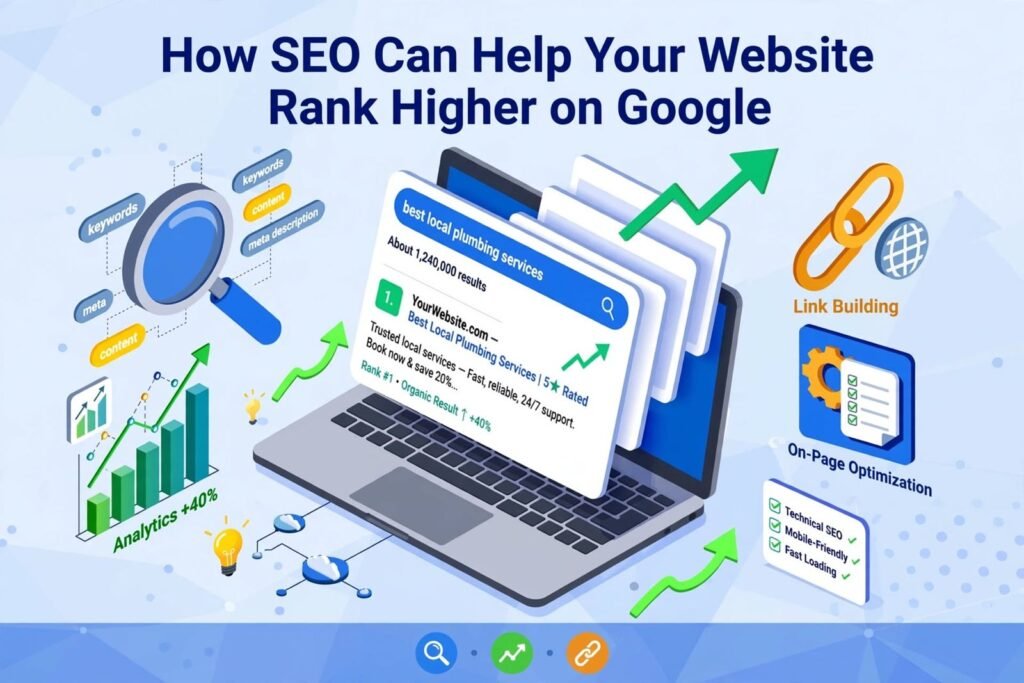
In today’s digital world, having a website is not enough to grow a business online. Your website needs to be visible when potential customers search for products, services, or information related to your business. This is where Search Engine Optimization, commonly known as SEO, becomes important.
SEO is one of the most effective digital marketing strategies for improving a website’s visibility on search engines such as Google. A well-optimized website has a better opportunity to appear in relevant search results and attract organic visitors.
For businesses of all sizes, SEO can help increase website traffic, build credibility, generate leads, and support long-term growth. Unlike paid advertising, where businesses pay for clicks or impressions, SEO focuses on improving organic visibility.
What Is SEO?
Search Engine Optimization is the process of improving a website so that search engines can understand its content and provide it to users searching for relevant information.
When someone searches for something on Google, the search engine analyzes many factors to determine which pages are most relevant and useful for that search.
SEO helps your website communicate clearly with search engines while also providing a better experience for visitors.
For example, imagine you own a digital marketing agency and someone searches for “digital marketing services for small businesses.” If your website contains useful, relevant content optimized around that topic, it may have a better chance of appearing in search results.
SEO is not about trying to trick Google. It is about creating a website that is useful, trustworthy, technically sound, and relevant to what people are searching for.
Why Is SEO Important for Your Website?
Most online experiences begin with a search. People use search engines to find businesses, compare products, learn about services, and solve problems.
If your website does not appear on the first few pages of search results, potential customers may never discover your business.
SEO helps improve your website’s visibility and allows you to reach people who are already searching for something related to your business.
Some major benefits of SEO include:
- Increased organic website traffic
- Better search engine visibility
- Improved brand credibility
- More potential customers
- Increased leads and enquiries
- Better user experience
- Long-term online growth
- Keyword Research Helps You Reach the Right Audience
Keywords are one of the foundations of SEO.
A keyword is a word or phrase that people type into search engines when looking for information, products, or services.
For example, someone looking for a digital marketing professional might search for:
- Digital marketing services
- SEO services
- Social media marketing
- Google Ads services
- Digital marketing agency near me
Keyword research helps you understand what your target audience is searching for.
Once you identify relevant keywords, you can naturally use them in your website content, headings, page titles, URLs, and other important areas.
However, keyword usage should always be natural. Repeating the same keyword excessively can make content difficult to read and may create a poor user experience.
The goal is to create content that answers the user’s search intent rather than simply filling a page with keywords.
- High-Quality Content Improves Visibility
Content plays a major role in SEO.
Search engines aim to provide users with helpful and relevant information. Creating high-quality content can help your website demonstrate expertise and answer the questions your audience is asking.
You can publish:
- Blog posts
- Guides
- Tutorials
- Case studies
- FAQs
- Service pages
- Product descriptions
- Industry insights
For example, a digital marketing website can publish blogs about SEO, social media marketing, Google Ads, content marketing, and online branding.
Useful content can attract visitors and encourage them to spend more time exploring your website.
The more valuable your content is to your audience, the greater its potential to earn visibility, links, shares, and returning visitors.
- Optimizing Page Titles and Headings
Page titles and headings help both users and search engines understand what a webpage is about.
Your page title should clearly describe the main topic of the page. It should also be relevant to the search terms your target audience may use.
Headings such as H1, H2, and H3 help organize content into clear sections.
For example, an SEO blog could use headings such as:
H1: How SEO Can Help Your Website Rank Higher on Google
H2: What Is SEO?
H2: Why Is SEO Important?
H2: How Keyword Research Helps
H2: The Importance of Quality Content
Clear headings make content easier to read and help search engines understand the structure of your page.
- Improve Your Website’s User Experience
SEO is not only about keywords and content. User experience also matters.
When visitors come to your website, they should be able to find the information they need quickly and easily.
A good website should be:
- Easy to navigate
- Mobile-friendly
- Fast-loading
- Clear and organized
- Easy to read
- Secure
- Accessible across different devices
If visitors struggle to use your website, they may leave quickly and look for another website.
Creating a smooth user experience can help visitors engage more effectively with your content and services.
- Mobile-Friendly Websites Are Essential
A large number of people access websites using smartphones and tablets.
Therefore, your website should work properly on mobile devices.
A mobile-friendly website should have readable text, easy-to-use buttons, responsive layouts, and navigation that works well on smaller screens.
If your website looks good on a desktop but is difficult to use on a smartphone, you may lose potential customers.
Mobile optimization is therefore an important part of maintaining a strong online presence.
- Website Speed Can Affect User Experience
Nobody likes waiting for a website to load.
A slow website can frustrate visitors and increase the possibility that they will leave before viewing your content.
Improving website performance can include optimizing images, reducing unnecessary scripts, using efficient hosting, and keeping the website technically healthy.
A faster website provides a better experience for visitors and can support your overall SEO efforts.
- Build Quality Backlinks
Backlinks are links from other websites pointing to your website.
When reputable and relevant websites link to your content, it can help demonstrate that your website provides valuable information.
However, not all backlinks are equally useful. The quality and relevance of the linking website matter.
Businesses can earn backlinks by creating useful resources, publishing original research, contributing expert insights, creating shareable content, and building genuine relationships within their industry.
The focus should be on earning natural, high-quality links rather than trying to obtain a large number of low-quality links.
- Local SEO Helps Local Businesses
If you operate a local business, Local SEO can help you reach customers in your area.
For example, a salon, restaurant, clinic, real estate business, or digital marketing agency may want to attract customers from nearby locations.
Local SEO involves optimizing your online presence for location-based searches.
You can include relevant location information on your website, create useful local content, and maintain accurate business information across online platforms.
For example, instead of targeting only “digital marketing services,” a local business might target a more specific phrase such as “digital marketing services in Kerala.”
Local SEO can help businesses become more visible to people searching for nearby products and services.
- Internal Linking Strengthens Website Structure
Internal links connect one page of your website to another page on the same website.
For example, a blog about SEO could link to your SEO service page. A blog about social media marketing could link to your social media marketing service.
Internal linking helps visitors discover related information and makes website navigation easier.
It can also help search engines understand the relationship between different pages on your website.
A well-organized internal linking structure can make your website easier to explore and understand.
- Optimize Images for SEO
Images can make website content more attractive and engaging, but they should also be optimized.
Large image files can slow down your website. Compressing images can help improve loading performance.
You should also use descriptive file names and appropriate alternative text where relevant.
For example, instead of using a file name such as “IMG1234.jpg,” a descriptive name such as “social-media-marketing-strategy.jpg” provides more useful context.
Image optimization supports both website performance and accessibility.
- Create SEO-Friendly URLs
Website URLs should be simple, descriptive, and easy to understand.
For example:
example.com/seo-services
is clearer than:
example.com/page?id=12345
A descriptive URL helps users understand what the page is about before clicking.
Including a relevant keyword in a URL can also provide additional context about the page.
- Use Meta Descriptions Effectively
A meta description is a short summary that can appear below a webpage title in search results.
A well-written meta description should clearly explain what users can expect from the page.
Although meta descriptions are not simply a direct ranking shortcut, they can influence whether people choose to click on your result.
A clear and compelling description can help improve the attractiveness of your search listing.
- Regularly Update Your Website Content
SEO is not a one-time activity.
Search trends, customer interests, competitors, and search engine systems continue to change.
Regularly reviewing and updating your content can help keep your website useful and accurate.
You can update old statistics, improve outdated information, add new examples, improve readability, and expand pages that provide valuable information.
Refreshing existing content can be an important part of a long-term SEO strategy.
- Track SEO Performance
One of the biggest advantages of digital marketing is the ability to measure performance.
Businesses can monitor different SEO metrics to understand how their website is performing.
Important metrics may include:
- Organic traffic
- Keyword rankings
- Click-through rate
- Impressions
- Conversions
- Leads
- Engagement
- Website performance
Tracking these metrics helps identify what is working and what needs improvement.
For example, if a blog receives a large number of visitors but generates very few enquiries, you may need to improve the page’s calls to action or conversion experience.
- SEO Builds Long-Term Credibility
When a website consistently provides useful information and appears in relevant search results, users may begin to recognize the brand.
Higher visibility can contribute to brand awareness and credibility.
People often trust businesses that provide clear information, professional websites, helpful content, customer reviews, and strong online visibility.
SEO can therefore support not only traffic growth but also the overall reputation of a business.
SEO vs. Paid Advertising
SEO and paid advertising are both valuable digital marketing strategies, but they work differently.
With paid advertising, businesses pay to display advertisements to targeted audiences. It can produce quick visibility, but traffic generally depends on continued advertising investment.
SEO focuses on improving organic visibility. It usually takes time to produce strong results, but successful SEO can provide sustainable traffic over a longer period.
Many businesses use both strategies together.
Paid advertising can provide immediate exposure, while SEO can build long-term organic visibility.
Common SEO Mistakes to Avoid
Businesses should avoid practices that can harm their website performance.
Common mistakes include:
- Keyword stuffing
- Copying content from other websites
- Using poor-quality backlinks
- Ignoring mobile optimization
- Having a slow website
- Publishing content without understanding search intent
- Using unclear website navigation
- Ignoring analytics
- Forgetting to update old content
SEO should always focus on creating value for users.
How Long Does SEO Take?
SEO does not usually produce overnight results.
The time required can depend on factors such as website age, competition, industry, content quality, technical condition, backlinks, and the overall SEO strategy.
Some improvements may be noticed relatively quickly, while significant organic growth can take several months.
The most important thing is consistency.
Businesses should treat SEO as a long-term investment rather than a quick marketing campaign.
Conclusion
SEO can play a major role in helping your website become more visible on Google and reach the right audience.
From keyword research and high-quality content to technical optimization, mobile responsiveness, website speed, internal linking, backlinks, and local SEO, there are many factors that contribute to a successful SEO strategy.
A strong SEO strategy does more than improve search rankings. It can increase organic traffic, build credibility, generate leads, improve user experience, and support long-term business growth.
For businesses that want to succeed online, SEO should be an important part of their digital marketing strategy.
The key is to focus on users first, create valuable content, maintain a technically healthy website, monitor performance, and continuously improve.
With patience, consistency, and the right strategy, SEO can help your website gain greater visibility and create more opportunities for business growth.